There are plenty of good reasons to ride an electric bike instead of driving. They’re not just practical for daily errands, but also support a healthier lifestyle and help reduce your environmental impact.
While those benefits are priceless, the financial side is easy to measure. When you compare ebike vs car costs, the savings add up quickly. Whether you’re riding a commuter ebike or cargo ebike, you could be saving more than US$8,000 a year, and with fuel prices continuing to rise in 2026, that number can climb even higher. Let’s break it down.
Contents
- What costs are associated with driving a car?
- What are operating costs?
- What are ownership costs?
- Ebike vs cars: So, how much money could I save in total?
- References
What costs are associated with driving a car?
When it comes to vehicle expenses, there are two main types: operating costs and ownership costs.
While car payments are a separate cost category, we won’t dive into those here. What we will say is that both the operating and ownership costs of an e-bike are significantly lower than those of a car.
What are operating costs?
Operating costs are the day-to-day expenses of using a vehicle, including fuel, maintenance and repairs, parking, and tolls (if any). Among these, fuel is typically the largest ongoing expense for drivers, with every trip adding to the cost, especially as global events drive fuel prices higher and make them more unpredictable.
Fuel prices around the world
To put things in perspective, gas prices vary widely per country. As of early 2026, the global average is about US$5.64 per gallon, but the range is significant.[1]
- United States: around US$4.099 per gallon[2]
- Europe (e.g. Germany, Netherlands, UK): roughly US$8.00 to $10.00 per gallon
- Asia (e.g. Japan, Taiwan): around US$3.90 to $4.00 per gallon
- Oil-producing countries: can be much lower due to subsidies
These differences largely come down to local taxes and subsidies, which means your actual savings from switching to an ebike can vary quite a bit depending on where you live.
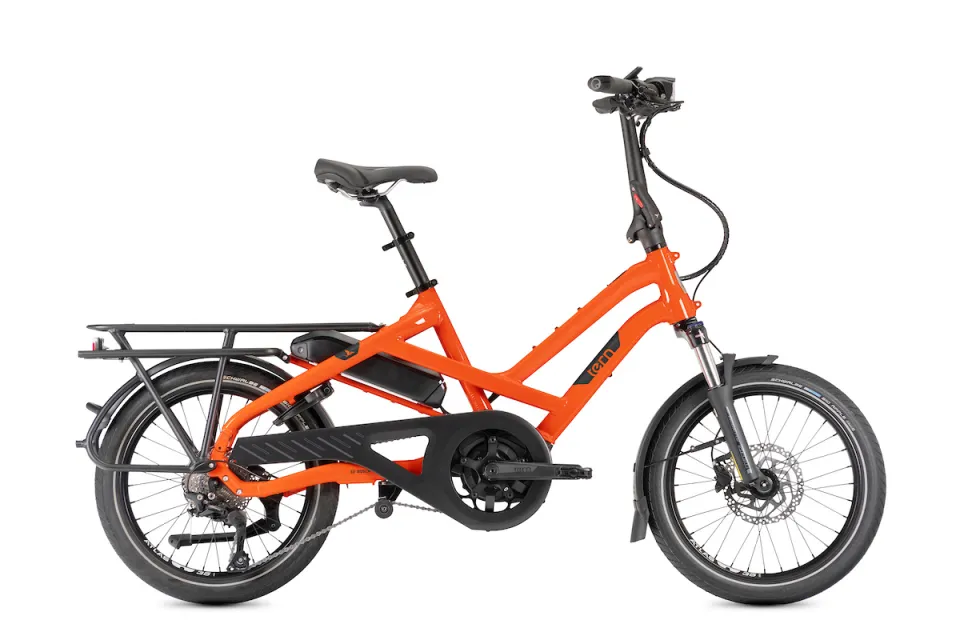
To help you visualize ebike vs car operating costs, we’ve taken a medium sedan and the Tern HSD P10 cargo electric bike as examples.
In the following, we’re going to assume a 10-mile (16 km) daily ride—let’s say you drop your kid off at daycare, head to work, and then pick them up on the way home.
Operating costs for riding an ebike vs driving: How much cheaper is it?
Note: This analysis is based on 2025 benchmark data, adjusted to 2026 conditions using current fuel prices and inflation estimates. Data is sourced from the US, with all values presented in USD. Fuel prices in 2026 remain volatile and are currently about 30% higher than 2025 levels.
10-mile trip operating cost breakdown in 2026
| 
| 
|
|---|---|---|
| Gas-Powered Car (Medium Sedan) | Tern HSD P10 (Gen 2) Electric Cargo Bike |
Fuel | $0.143 x 10 = $1.43[3] | $0.1568 per kWh x 0.072 kWh ≈ $0.01 per 10 miles [4] |
Maintenance, Repair, & Tires | $0.12 x 10 ≈ $1.20[5] | $0.12 x 10 ≈ $1.20[6] |
On-street, 1-hour parking | $2.84[7] | Free |
TOTAL | $1.43 + $1.20 + $2.84 = $5.47 | $0.01 + $1.20 = $1.21 |
Operating cost savings for a 10-mile round trip: $5.47 - $1.21 = $4.26
If we go a bit further, replacing just one average car trip with an electric bike ride five days a week for a year can save you at least US$1,107.60—and likely more if you factor in parking costs.
Annual operating cost savings: $4.26 x 5 days per week x 52 weeks per year = $1,107.60
How much does it cost to fully charge an e-bike per year?
On average, it takes under $3.00 worth of electricity to power an e-bike for an entire year. Let’s break down how much you pay for fully charging an HSD P10 once.
- As mentioned before, electricity costs $0.1568 per kWh in 2026.
- The P10 runs on a Bosch PowerPack 545 Wh, which is the equivalent of 0.545 kWh.
Cost to fully charge a Tern HSD P10’s battery: $0.1568 x 0.545 ≈ $0.085
You pay approximately $0.085 to charge the battery for up to 76 miles, which is the HSD P10’s maximum range. And let’s say you ride your bike 10 miles daily, 5 days a week, 52 weeks per year:
Total yearly distance | 10 miles daily x 5 days weekly x 52 weeks = 2,600 miles |
|---|---|
Battery charges per year | The HSD has a max range of 76 miles per full charge, so: 2,600 / 76 ≈ 34 charges |
Cost per charge | From before, 1 full charge (545 Wh, or 0.545 kWh) ≈ $0.085 |
Total annual cost | 34 charges x $0.085 ≈ $2.89 |
You’d spend about $2.89 per year on electricity to commute 10 miles a day, 5 days a week, on your HSD P10 cargo ebike.
Other operating costs to keep in mind
Parking fees, fines, and… time
If you live in a city where parking is a daily headache (and expense), chances are our charts underestimate how much you’d save. Think about parking tickets—we’ve all been there! And let’s not forget: time is currency, too. The minutes you spend circling for a spot do add up, and we didn’t even include that in our calculations.
Rising costs as your car gets older
Cars need more TLC as they age, which means more money out of your pocket. The older your car, the more you stand to save on maintenance by choosing to ride an electric bike instead. And here’s the great part: you don’t even need to give up your car to see savings. Every trip you take on your e-bike instead of driving chips away at your overall expenses.
While an ebike seems like a significant investment at first, it pays off in quality, safety, and long-term value thanks to thoughtfully selected components and rigorous safety standards.
More reading: Why Good Electric Bikes Don’t Come Cheap (But Are Worth Every Penny)
What are ownership costs?
Have you ever thought about going car-free entirely?
That might mean going fully car-free or letting go of your family’s second car. To see how much you’d save, you’ll want to look at ownership costs, too. Not just what it costs to use a vehicle, but what it costs to have one. That includes things like insurance, depreciation, registration, taxes, and any finance charges you might be paying. So, how do electric bikes and cars compare when it comes to ownership costs? Let’s break it down again.
Ebike vs car ownership cost breakdown in 2026
Annual ownership cost savings: $7,664.09 - $691.86 = $6,972.23
How much could you save by switching from a car to an e-bike?
Total cost savings: $6,972.23 + $1,107.60 = $8,079.83
Even without factoring in everyday costs like fuel and parking, switching from a car to an electric bike could save you around $7,000 per year in ownership costs alone. And if you drive something larger than a midsize sedan, this number can only go up! Once you also factor in the bike’s much lower operating costs, the total savings become even more significant. That’s money you can use for the stuff that actually matters to you, like your mortgage, vacation plans, or just having a little extra financial breathing room.
Ebike vs cars: So, how much money could I save in total?
The answer is: quite a lot!
In our medium sedan vs. HSD P10 comparison above, we’ve assumed that you ride the HSD 10 miles daily to bring your kid to daycare, go to work, and go home together.
Just based on lower operating costs alone, you'd be saving more than $1,000 annually. Now factor in the $7,000 you'd save by not owning a second car, and you’re looking at $8,000 back in your pocket every year. And our calculations didn’t even include using the HSD cargo bike for grocery runs and running errands—another 5 miles a week, give or take.
Imagine what you could do with all that money: go on a vacation, renovate your home, or just have less financial stress. You could even budget for another e-bike for your spouse, helping them ride more and reduce car use while lowering your family’s overall vehicle costs even further.
Learn more: How Much Should You Budget For a Good Electric Bike?
Of course, these are estimates, and your actual savings will depend on your lifestyle and habits. But why not sit down with your own numbers and see what kind of difference an electric bike could make for your family? And don’t forget: all that fresh air and movement? It might save you a gym membership or a few doctor’s visits, too.
Curious to see what it’s like? Find your nearest Tern dealer and take a test ride!
References
- GlobalPetrolPrices.com. "Gasoline Prices." Accessed April 27, 2026.
- AAA (American Automobile Association). “National Average Gas Prices.” Accessed April 27, 2026.
- Fuel cost for a medium sedan is $1,669 annually at 15,000 miles, or about $0.11 per mile (AAA, 2025 Your Driving Costs - Brochure). Based on this, miles per gallon (MPG) for a medium sedan is calculated as $3.151/gallon ÷ $0.11/mile = 28.65 miles/gallon (AAA, 2025 Your Driving Costs - Fact Sheet, 2025). Using a 2026 fuel price of $4.099 per gallon (AAA, “National Average Gas Prices,” accessed April 27, 2026), 2026 fuel cost per mile is $4.099/gallon ÷ 28.65 miles/gallon ≈ $0.143/mile.
- Assumes the maximum battery range of the Tern HSD P10, which is 545 kWh (0.545 Wh) for up to 76 miles (121 km). Electricity cost of $0.1568 per kWh as of 2026. US Energy Information Administration, Table 5.6A, Average Price of Electricity to Ultimate Consumer by End-Use Sector > Transportation, January 2026, U.S. Total.
- 2026 amount. Based on the 2025 Your Driving Costs - Brochure by AAA, maintenance for a medium sedan is $1,786 annually at 15,000 miles, or about $0.12 per mile. To reflect 2026 purchasing power, we adjusted this and all following rates in this article using the U.S. Bureau of Labor Statistics CPI Inflation Calculator.
- 2026 amount. Assumes approximately $300 in annual maintenance costs for the Tern HSD P10, including common consumables such as brake pads, chain, cassette, and tires, plus general service. Based on a 10-mile daily commute, five days a week, this equals 2,600 miles per year (10 × 5 × 52). This corresponds to about $0.12 per mile ($300 ÷ 2,600), or $1.20 per 10 miles.
- 2026 amount. Based on the Global Parking Index 2022 by Parkopedia, Boston was the least expensive U.S. city among the top 50 for two-hour on-street parking, at $4.83 per two hours ($2.42 per hour). Using the CPI Inflation Calculator, $2.42 in 2022 is equivalent to about $2.84 in 2026.
- 2026 amount, based on $1,572 in 2025. AAA, 2025 Your Driving Costs - Brochure, 2025. Full-coverage insurance for a medium sedan is $1,572 annually at 15,000 miles.
- According to BikeInsure, the cost of insuring an ebike starts at $16 per month, or $192 per year. BikeInsure, How Much Does Ebike Insurance Cost?, accessed April 30, 2026. This is an indicative amount, as actual premiums vary by bike type, value, and coverage details.
- 2026 amount, based on $613 in 2025. AAA, 2025 Your Driving Costs - Brochure, 2025.
- 2026 amount, based on $3,462 in 2025. AAA, 2025 Your Driving Costs - Brochure, 2025.
- For the HSD P10, assuming a straight-line depreciation over a 7-year period: $3,499 (MSRP) ÷ 7 ≈ $499.86.
- 2026 amount, based on the $854 in 2025. 2025 Your Driving Costs - Brochure, AAA, 2025.
Related Articles