Whether you're using our electric bikes, cargo bikes, or electric cargo bikes to carry your kids or just to have fun, we want you to be safe. We believe bikes everywhere should adhere to high safety standards to ensure they are fit for use. So while making cool bikes is important to us, making safe bikes is an even higher priority.
In this article, we'll tell you everything you ever wanted to know about how we put our cargo-carrying, kid-hauling e-bikes and non-electric bikes through rigorous testing to make sure they're safe and reliable up to their claimed load limit.
1. How Safety Begins
If we are creating a vehicle to carry our loved ones, we want to make sure that the bike is purposely designed for a certain load limit from the very beginning, before we even build a prototype.
We start by defining the limits under which the bike will operate, including:
- The bike's load limits (see below)
- The maximum weight of the rider, and
- The terrain where the bike is permitted to be used.
With these limits in mind, we use specialized software to simulate the stresses we expect the bike's frame and fork to face. The software helps get us in the right ballpark before we start making real prototypes.
More: What Are My Bike's Load Limits?
Maximum gross vehicle weight (MGVW) is a key concept to understand your bike's load limit. The MGVW includes the weight of the bike and the rider, plus any accessories, cargo, and/or passengers.

* Bicycle = weight of the bike plus any batteries; ** Rider(s) = weight of the cyclist and any passengers
In addition to MGVW, your bike's load limit also depends on its rear rack capacity. So we have designed and tested our cargo and passenger-carrying bikes to the following load limits:
Bike | MGVW | Rear Rack |
|---|---|---|
GSD (Gen 3) | 210 kg (463 lb) | 100 kg (220 lb) |
GSD (Gen 1 & Gen 2) | 200 kg (440 lb) | 100 kg (220 lb) |
HSD (Gen 2) | 180 kg (397 lb) | 80 kg (176 lb) |
HSD (Gen 1) | 170 kg (374 lb) | 60 kg (132 lb) |
NBD | 140 kg (308 lb) | 27 kg (59 lb) |
Orox | On-road: 210 kg (463 lb) | 100 kg (220 lb) |
Quick Haul | 150 kg (330 lb) | 50 kg (110 lb) |
Quick Haul Long | 190 kg (419 lb) | 90 kg (198 lb) |
Short Haul | 140 kg (308 lb) | 50 kg (110 lb) |
2. How We Test Our Bikes
Tern Testing: Build It, Ride It, Improve It
The next step is to make and ride a series of prototype bikes. We typically put a few thousand miles on these, making improvements with each new prototype design.

To make sure the product development team gets well-rounded feedback from all kinds of riders, we encourage team members organization-wide to ride these bikes. Feedback from Tern team riders across a wide variety of roles helps the product development team make improvements to the initial design.
After this lengthy iterative design process, we begin lab testing the frame and fork to ensure that they can withstand the forces associated with the claimed weight capacity. We perform multiple rounds of internal testing on-site at our factory using the relevant testing standards.
During internal testing, we generally try to "test to destruction" to identify the weakest parts of the frame or fork. However, a few of our recent frames have just been too strong for that—and at that point, our lab turns the machines off.
Next, we move on to even more demanding testing at an external laboratory to see how well our bikes meant for heavier riders and loads measure up to the industry-recognized German cargo bike standard—DIN 79010.
Independent Lab Testing: DIN 79010 and Beyond
In effect since 2020, DIN 79010 Cycles - Transportation bikes and cargo bikes developed by the German Institute for Standardisation is the first standard to specify rigorous testing methods and safety requirements of electric and non-electric cargo bikes to ensure structural integrity and overall safety of these bikes for riders, passengers, and others who share the road.
Different from conventional bike standards used to test and evaluate lighter, single-rider traditional bikes and city e-bikes, DIN 79010 focuses solely on cargo bikes and includes significantly higher load-bearing tests for the frame and fork, specific test requirements for the braking system, additional safety tests for child passengers, tests to simulate extreme overload scenarios, and much more, in order to account for the heavily-loaded nature of such bikes.
To see if our bikes meet the testing methods and safety requirements specified by DIN 79010, we send them off to accredited independent testing labs such as Germany-based EFBE Prüftechnik for some serious testing.
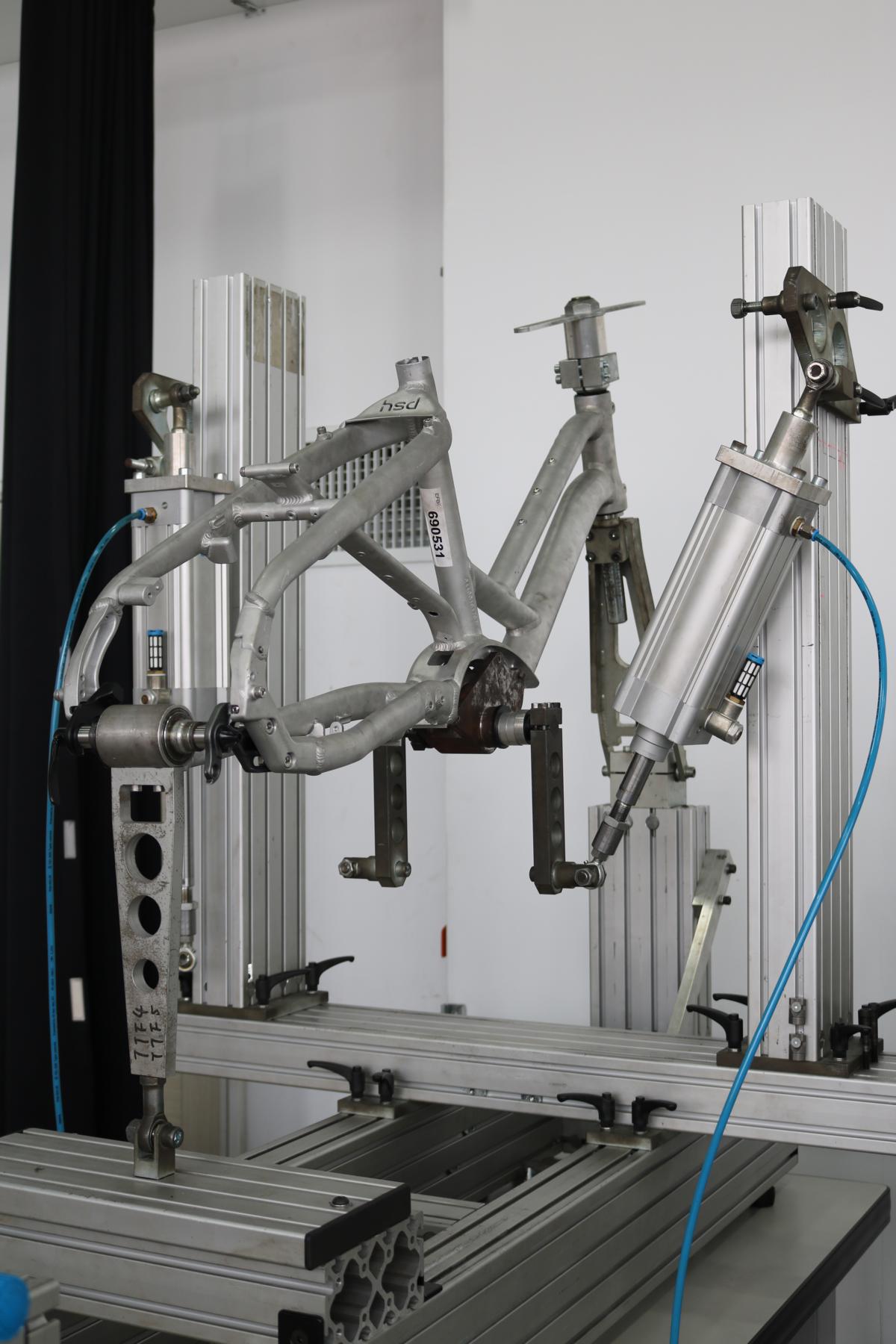
At EFBE, many of our bikes are actually tested well beyond DIN 79010 requirements. Specifically, the frames and forks of these bikes go through extensive testing simulating hundreds of thousands of cycles of multi-directional stress, and are truly taken to their limits using EFBE's custom testing protocol—the Tri-Test.
Built upon DIN 79010, the EFBE Tri-Test simulates the stresses compounded by various loads endured by a bike throughout its entire lifespan, unleashing a series of grueling fatigue tests, maximum load tests, and overload tests on the components to ensure that passenger and cargo-hauling bikes are safe and reliable under heavy load.
In summary, the frame and fork as well as overall safety of each of our bikes that are designed with cargo and/or passenger capacity—like the GSD, HSD, Quick Haul, Quick Haul Long, Orox, NBD, and Short Haul—all meet a minimum of the DIN 79010 safety standard up to their claimed load limits. Yup. We are that serious about our bikes’ safety.
More: What Makes the EFBE Tri-Test So Demanding?
The EN City/Trekking Bike standard, a European standard for ordinary city bikes, requires a single test condition for all bikes, with no adjustments for different usage scenarios. But since the heavy loads that cargo bikes carry change and magnify the forces on the bike's frame and fork, DIN 79010 requires test forces that scale with system weight (meaning the weight of the bike, rider, and any cargo or passengers).
This scaling makes EFBE's Tri-Test—which is based on DIN 79010—much more rigorous than testing for ordinary city bikes. The Tri-Test includes 10 demanding stress tests using forces proportionate to the bike's claimed load. One single frame must pass all 10 tests, so any damage to the frame or fork caused by one test will carry over to the remaining tests.
Knowing just how intense the Tri-Test process is gives us peace of mind that our bikes are fit for use. For instance, the amount of stress applied in one of our GSD e-cargo bike's fork tests was over 300% greater than the amount applied to a fork in the EN City/Trekking Bike test.
Why does that matter? Imagine the amount of braking force applied by a strong disc brake when trying to slow a 210 kg vehicle—the fork must be properly designed to be safe in those conditions (and as you can see from the GSD, you end up with a pretty burly-looking fork!).
Testing the Rack for Strength and Stiffness
Beyond a bike’s frame and fork, racks also have weight capacities. And there is a European test standard for racks to test their strength.
But we find that this standard isn’t comprehensive enough. Just because a rack is strong enough to support a certain weight doesn’t mean that it’s stiff enough to prevent uncomfortable and unnerving sway while you ride. You don’t want to feel sway when you’re threading between cars in traffic, and your child on the back rack moves slightly.
So when we give a weight limit for a rack, it means that we’ve already tested the rack at the claimed weight capacity—and then some—using the European standard. Plus, we’ve done hundreds or thousands of kilometers of ride testing to ensure that the bike is comfortable and safe when the rack is fully loaded.
That's how we know it's safe to load up our bikes’ rear rack with plenty of cargo, as long as the total MGVW of each bike is observed.
3. Do All Companies Test Their Bikes This Way?
Some do, but many don't.
In the bicycle industry, companies are only required to self-certify that their bikes meet certain safety standards. But the lack of a standard for cargo bikes has made this hard for bike companies that make cargo and e-cargo bikes. In fact, most standard test machines can't even accommodate a long cargo bike.
The bike companies that are committed to testing devise their own custom tests that require them to make custom jigs with companies like EFBE. It's a costly and time-intensive process, but we think ensuring the safety of riders and passengers is more than worth it.