
Mountain Bike Trail Work in Scotland with the Tern Orox
Across Scotland, trail enthusiasts ride a network of mountain bike trails that wind through forests and across hillsides. The trail maintenance needed to keep these routes open most often comes from trail-building volunteers, local crews whose bike trail work has become an integral part of the wider mountain bike (MTB) community.
In Tayside and Perthshire, that work is led by the Tayside Trail Association (TTA), a volunteer-run nonprofit working to keep the area’s wild trails safe and rideable. What began as a small group of motivated mountain bikers has grown into a regional effort caring for trails across Pitmedden, Kinnoull and Deuchny, Dunkeld and Birnam, and Ballo, four distinct zones maintained by dedicated local crews.
For Graham Barry, a long-time volunteer, the connection between riding and stewardship is simple.
“If you’re coming and riding in these places, you have a responsibility to come and help maintain them and look after them as well. The trails don’t build themselves. The trails don’t look after themselves.”
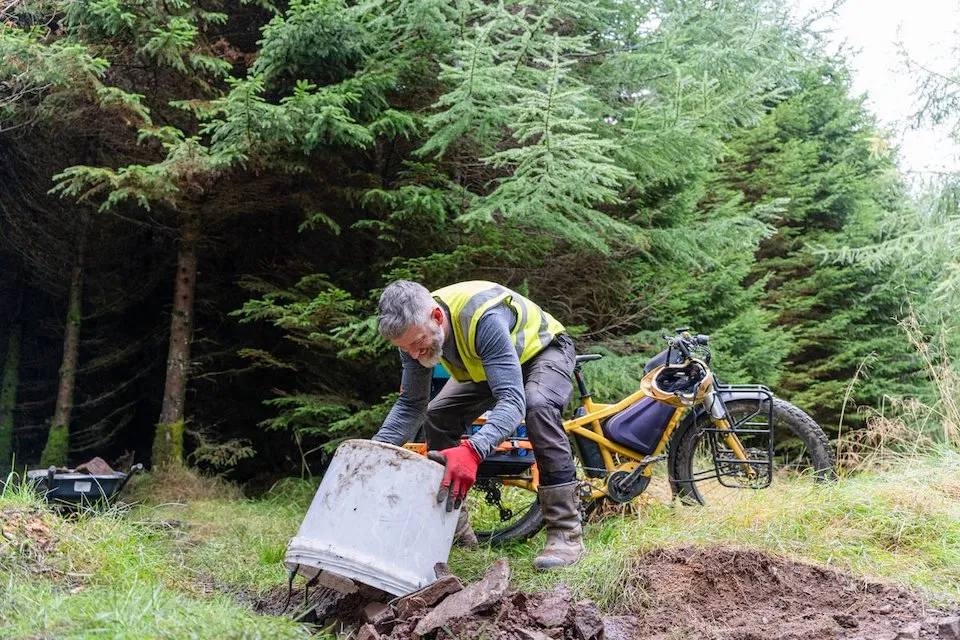
Powering bike trail work
Tools that support bike trail work are especially valuable in places where vehicles can’t reach. Unlike staffed venues with machinery and dedicated maintenance teams, these trails lie deep in the woods or across exposed hillsides, accessible only by narrow paths or steep forest tracks. Working in these environments is demanding.
“We build trails and features deep in the woods,” Graham explains. Usually, the team has to walk in with the tools, carrying the rock and material to places that aren’t easy to get to.
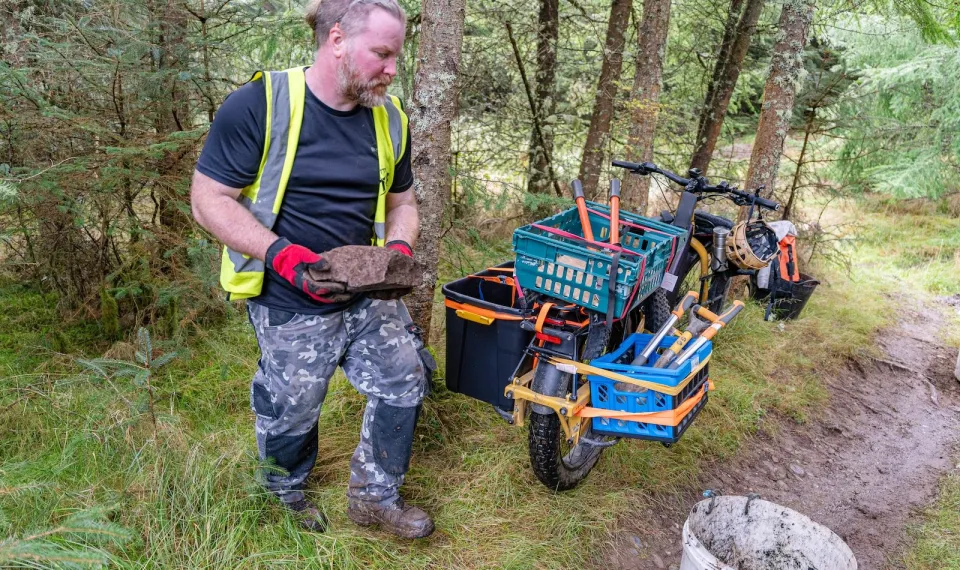
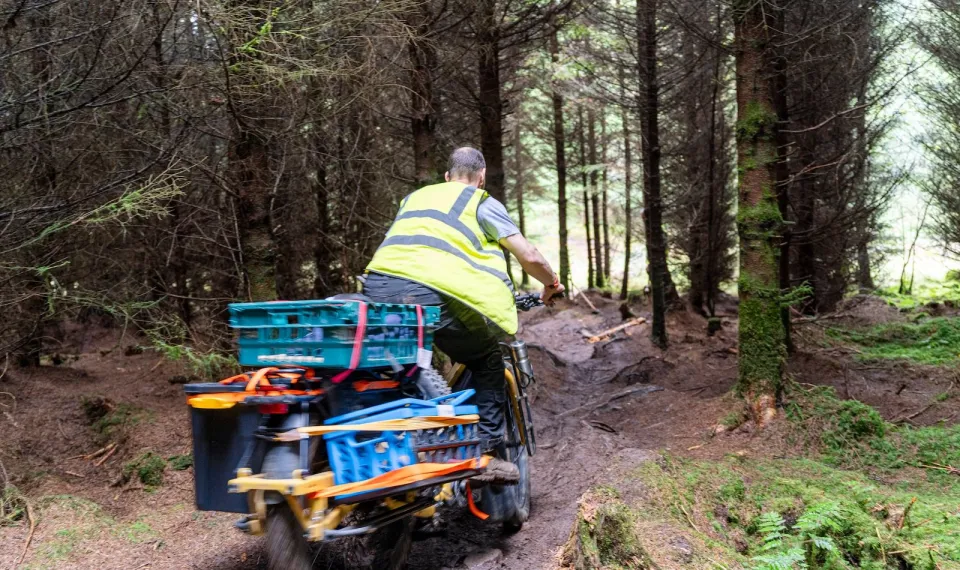
For crews working far from vehicle access, having reliable MTB trail work tools becomes essential. This year, the crew was introduced to a new type of tool: the Tern Orox, an electric cargo bike capable of safely hauling tools and heavy loads securely into rough, off-road terrain.
Most cargo bikes were never meant to venture into this kind of terrain, and eMTBs were not designed to carry heavy equipment safely over distance. The Orox is purpose-built to do both, hauling rock, dirt, and tools deep into the woods where the trail work actually happens. Certified by EFBE Prüftechnik (a leader in accredited mechanical testing for weight loads for bicycles and their components) for a 180 kg maximum gross vehicle weight when riding off-road, the Orox frame and fork have been rigorously tested to withstand rough ground, repeated impacts, and even small drops while fully loaded.
Learn more: How Tern tests bikes for safety
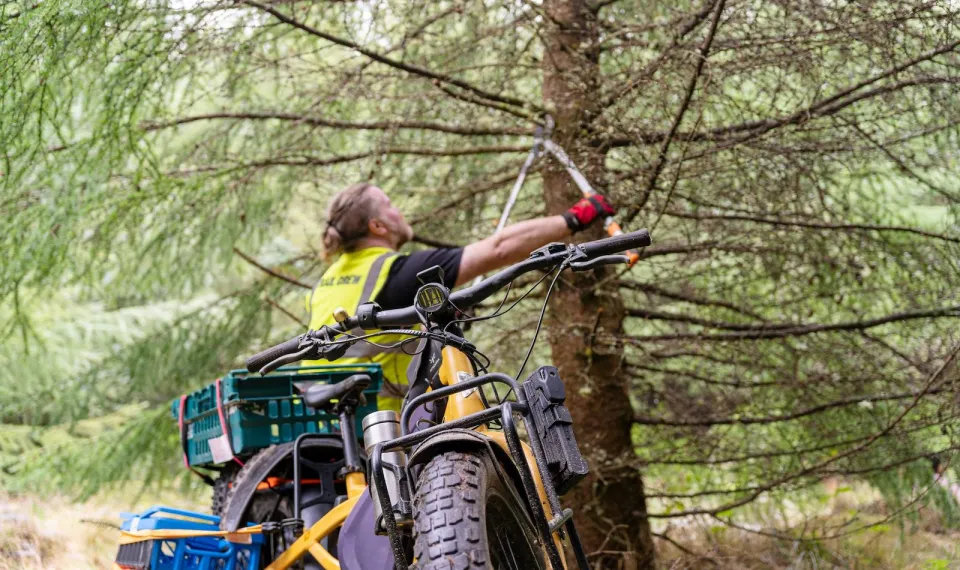
The off-road strength of the Orox is only part of what makes it essential for powering trail work. A bike hauling heavy loads over roots or rocky ground must also remain predictable and easy to control. The Orox is built for that reality. Its reinforced frame resists flex under load, and its geometry keeps the bike composed when transporting materials over rough terrain. Fat, grippy tires provide traction in wet, hilly environments, while the Bosch motor delivers the torque needed for steep access climbs, even under heavy load. For crews working across wide, remote areas, the dual-battery option provides the range needed for long days far from the trailhead.
Beyond the base bike, Tern’s modular accessories give crews real flexibility. Large-capacity panniers each carry up to 72 liters of tools, rocks, and materials, while a sturdy front Trail Rack manages lighter, bulkier items like buckets, signage, or first-aid kits. For trail work that constantly shifts from task to task, these attachments help turn the Orox into a true workhorse.
At a glance: Orox accessories
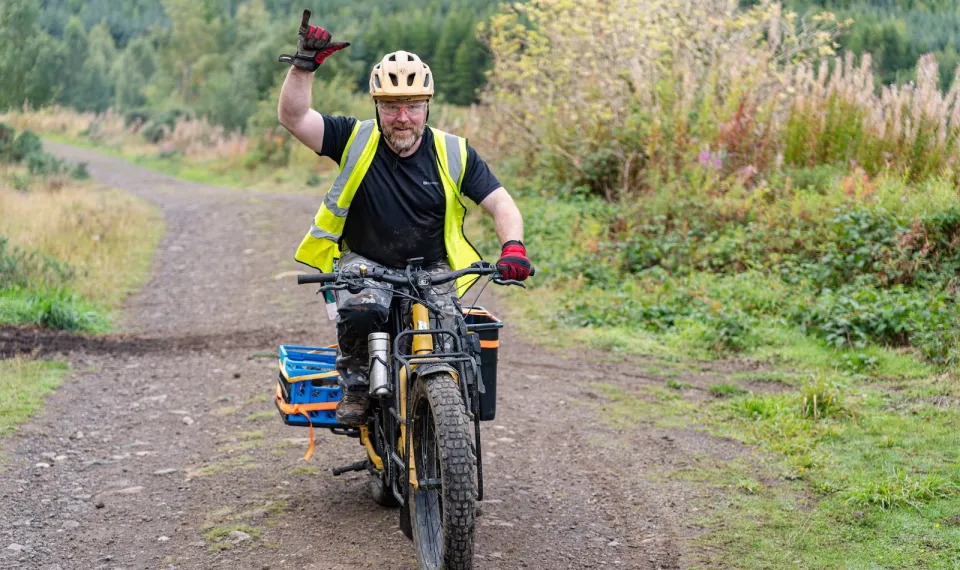
A game-changer for trail maintenance
TTA began using the Orox at an ideal moment, just as they were preparing the Ballo trails for the Scottish Enduro Championships. The trails needed reinforcement to withstand the surge of race traffic, which meant moving heavy materials efficiently and getting equipment to remote spots on the hill.
“We can use the Orox to bring materials in,” Graham says. “We can fix the problem areas so they can cope with that extra level of traffic associated with the race. And we can also use it to bring in race markers, signs, timing equipment, and get around.”
He adds, “We want to leave the trails in a better state than we found them. So again, having a bike that can lift whatever we need it to, and carry it to wherever we need it, it’s a game changer.”
Event officials also needed to reach remote sections of the course. While fire roads provided partial access, many key features lay beyond vehicle reach. A bike capable of hauling gear through tight forest corridors helped keep the entire operation running smoothly, from preparation to race day, to the final sweep.
These are just a few examples of how an off-road cargo bike can power trail work, giving volunteers a practical way to move equipment efficiently across large trail networks.
Learn more: The Tern Orox
Volunteering has its own rewards
Across Scotland, volunteer-driven trail care follows a similar pattern.
“More or less every bike area has a group of volunteers who are looking after it,” Graham says. “It is really just volunteers outside the trail centers doing what they can to keep everything running smoothly.”
And despite the challenges, trail building brings its own rewards. Spending time deep in the woods gives riders a richer understanding of the terrain. Graham explains how seeing features on foot when working the trail makes them easier to read on the bike, how riding improves as a result, and how just being in the forest offers real mental health benefits.
“It’s like building sandcastles when you’re a kid,” he says, “except more grown-up, and you get to ride bikes on it afterward.”
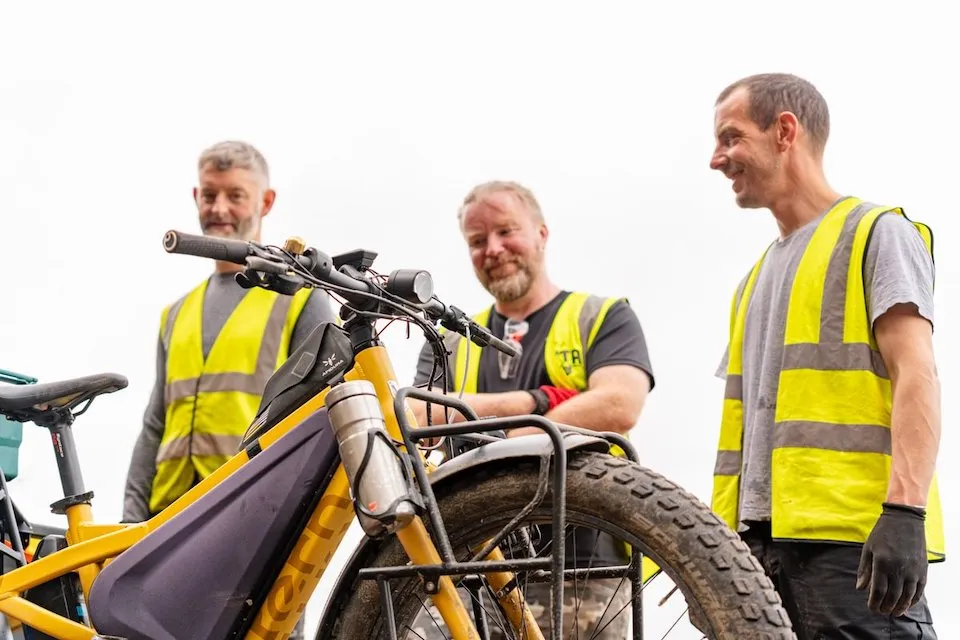
At the end of a long dig day, volunteers often share a well-earned beer, a small ritual that captures the camaraderie of a group whose work usually goes unseen but is felt by every rider who drops into a trail they’ve helped maintain. It’s a simple moment, but it reflects the deeper truth of trail stewardship: people coming together to care for the places they ride.
This year, their contribution has been recognized at the national level. Tayside Trail Association was recently awarded Best Trail Association at the Scottish Mountain Bike Awards, acknowledging their consistent, community-driven work across some of Scotland’s most beloved riding areas. Graham Barry was honored as a Local Hero, reflecting the leadership and passion he brings to volunteer trail care.
The impact of volunteers is real and lasting. Their trail maintenance efforts keep Scotland’s remote riding areas safe, open, and inspiring for every rider who passes through. With community support and the right tools in hand, associations like TTA can continue caring for the landscapes that make Scotland’s riding so special.
Watch: Trail Building with the Tern Orox
Related Articles
More info is coming